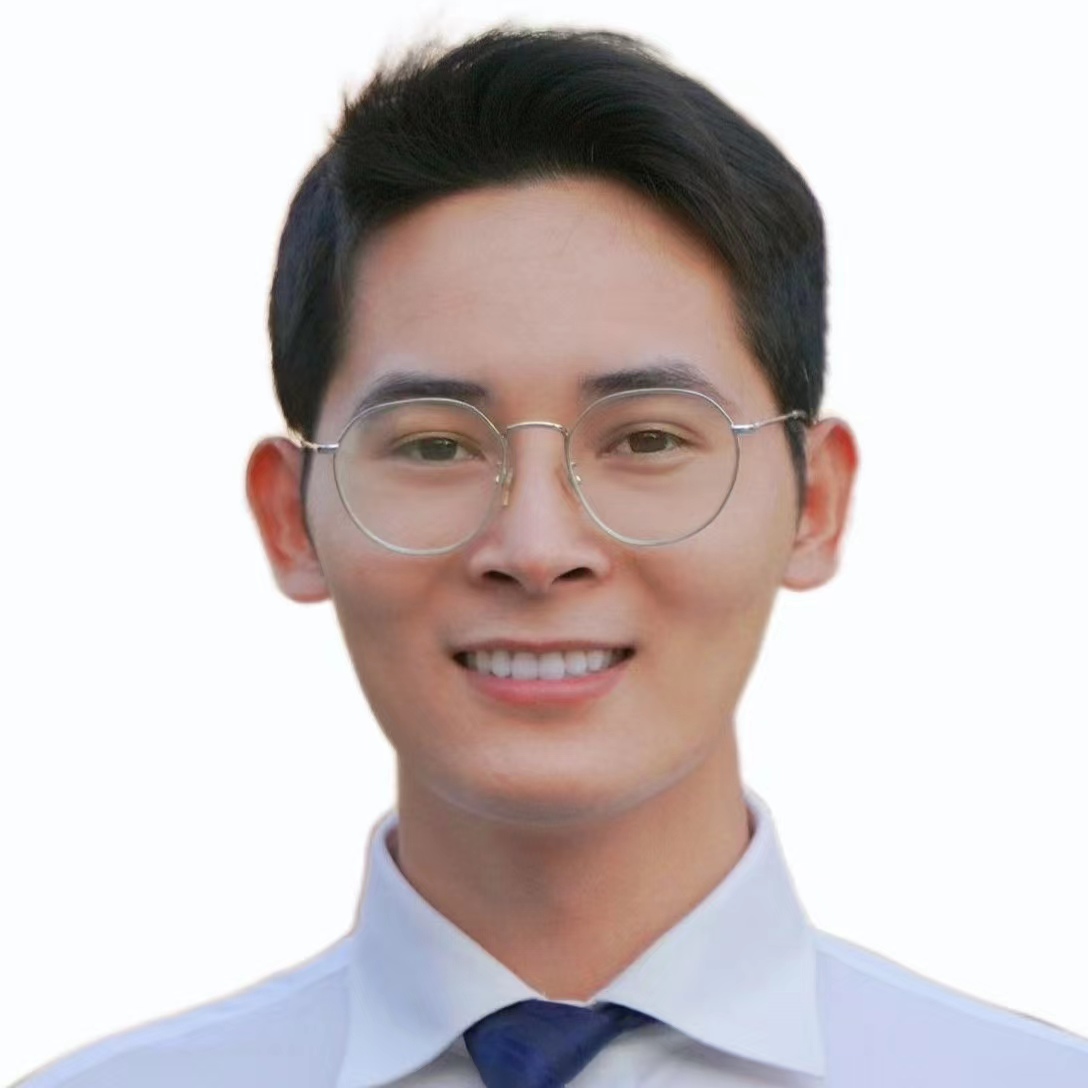
Last updated: 2025-12-04

😄 About Me


I have been a Ph.D. candidate at the School of Integrated Circuits, Shanghai Jiao Tong University (SJTU), since September 2022, under the supervision of Prof. Lei He (IEEE Fellow). I am also a research intern at the Eastern Institute of Technology (EIT), Ningbo. I obtained my B.S. and M.S. degrees in integrated circuit design at Xidian University.

📄 Download CV

🎯 Research Interests

  • Digital IC Design for AI Chips
  • Hardware/Software Co-Optimization
  • AI Compiler Development
  • FPGA-Based Accelerator
  • AI Models:Llama,dLLM,Mamba,VLA

🎓 Education

  • Shanghai Jiao Tong University (2022.09 – 2026.06)
    Ph.D. in Integrated Circuits Engineering
  • Xidian University (2019.09 – 2022.06)
    Master’s in Integrated Circuit Design
  • Xidian University (2015.09 – 2019.06)
    Bachelor’s in Integrated Circuit Design and Systems


🏆 Awards


📚 Publications


  • [1] CCF-A ASPLOS 2026 DFVG: A Heterogeneous Architecture for Speculative Decoding with Draft-on-FPGA and Verify-on-GPU. Shaoqiang Lu*, Yangbo Wei*, Junhong Qian, Dongge Qin, Shiji Gao, Yizhi Ding, Qifan Wang, Chen Wu, Xiao Shi, Lei He.
  • [2] CCF-A DAC 2025 MambaOPU: An FPGA Overlay Processor for State-space-duality-based Mamba Models. Shaoqiang Lu*, Xuliang Yu*, Tiandong Zhao, Siyuan Miao, Xinsong Sheng, Chen Wu, Liang Zhao, Ting-Jung Lin, Lei He.
  • [3] CCF-B ICCAD 2025 MoE-OPU: An FPGA Overlay Processor Leveraging Expert Parallelism for MoE-based Large Language Models. Shaoqiang Lu*, Yangbo Wei*, Junhong Qian, Chen Wu, Xiao Shi, Lei He.
  • [4] CCF-B TRETS Journal 2025,ISEDA 2024 MCoreOPU: An FPGA-based Multi-Core Overlay Processor for Transformer-based Models. Shaoqiang Lu*, Tiandong Zhao*, Ting-Jung Lin, Rumin Zhang, Chen Wu, Lei He.
  • [5] CCF-B ICCAD 2024 ChatOPU: An FPGA-based Overlay Processor for Large Language Models with Unstructured Sparsity. Tiandong Zhao, Shaoqiang Lu, Chen Wu, Lei He.
  • [6] CCF-C ASAP 2025 (Best Paper Nomination)👉 METAL: A Memory-Efficient Transformer Architecture for Long-Context Inference on FPGA. Zicheng He, Shaoqiang Lu, Tiandong Zhao, Chen Wu, Lei He.
  • [7] CCF-C ASP-DAC 2026 dLLM-OPU: An FPGA Overlay Processor for Accelerated Diffusion Large Language Models. Yangbo Wei*, Shaoqiang Lu*, Junhong Qian, Chen Wu, Xiao Shi, Lei He.
  • [8] CCF-C FPT 2026 FlightOPU: An FPGA Overlay Processor for LLM with HBM-Aware Multi-Die Architecture. Chen Wu, Shaoqiang Lu, Yangbo Wei, Junhong Qian, Jinlong Yan, Zhanfei Chen, Rumin Zhang, Xiao Shi, Lei He.
  • [9] CCF-A AAAI 2026 Mixture-of-Trees: Learning to Select and Weigh Reasoning Paths for Efficient LLM Inference. Yangbo Wei, Zhen huang, Shaoqiang Lu, Junhong Qian, Dongge Qin, Ting Jung Lin, Wei Xing, Chen Wu, Lei He.
  • [10] CCF-C FPL 2023 Token Packing for Transformers with Variable-Length Inputs. Tiandong Zhao, Siyuan Miao, Shaoqiang Lu, Jialin Cao, Jun Qiu, Xiao Shi, Kun Wang, Lei He.
  • [11] CCF-C FCCM 2025 C2OPU: Hybrid Compute-in-Memory and Coarse-Grained Reconfigurable Architecture for Overlay Processing of Transformers. Siyuan Miao, Lingkang Zhu, Chen Wu, Shaoqiang Lu, Jinming Lyu, Lei He.
  • [12] CCF-A Science China: Information Sciences 2025 FPGA Overlay processor for AI computing. He Lei, Wang Kun, Wu Chen, Tao Zhuofu, Shi Xiao, Miao Siyuan, Shaoqiang Lu.


🧰 Projects


Project 1: An FPGA-based Overlay Processor Unit for Accelerating AI Models


Description

  • Designed an FPGA-based Overlay Processor Unit (OPU) to accelerate inference of diverse AI deep learning models. Optimized data flow and operator execution through hardware–software co-design. Successfully deployed in real-time edge scenarios.

Responsibilities

  • Designed the OPU including the instruction set, compiler, and hardware microarchitecture.
  • Built a scalable computing engine for parallel execution of key operations (e.g., convolution, matrix multiplication).
  • Developed specialized functional units for nonlinear operations.
  • Implemented a real-time hardware–software runtime, covering CPU-side model compilation to FPGA inference.
  • Enabled PCIe-based transfer of weights and control instructions.
  • Designed for scalability across various sizes and types of neural networks.

Experimental Setup

  • Xilinx Alveo U200 @ 300 MHz (PE 600 MHz)
  • Implementation 4-Core OPU + 64 GB DDR4
  • Quantization Models run INT8 bitsandbytes.

Evaluation

  • Resources Usage (left) vs. Model Results (right) * We report the first token latency.
Resource LUT FF BRAM DSP   Model BERT ViT GPT2 LLaMA7B
Used 947684 1806396 1004 4364   Latency* (ms) 3.41 6.96 59.49 149.57
Util(%) 80.1% 76.3% 46.5% 63.8%   Throughput (TOP/s) 6.08 4.66 7.42 7.99

Tools

  • Vivado , FPGA (U200) , Verilog , ModelSim , PCIe , DDR , XDMA , C++ , Python , PyTorch

Mcore

Demo


Project 2:A Edge SoC with co-Accelerator in ARM Cortex-M3 for Face Detection


Description

  • Developed an Edge System-on-Chip (SoC) integrating an ARM Cortex-M3 processor with a dedicated hardware co-accelerator to enable real-time face detection. Deploy a decision-tree–based PICO (Pixel-Intensity Comparison-based Object Detection) model.

Responsibilities

  • Built a complete image acquisition, storage, and display pipeline with Bus peripheral access in software.
  • Implemented the face detection algorithm on Cortex-M3 for standalone execution.
  • Designed and integrated a dedicated hardware accelerator to boost detection performance.
  • Ran on a 100 MHz AX7103 FPGA with OV5640 (3-million-pixel) for image capture.
  • Data is stored in DDR3, HDMI for real-time display, and UART for status communication.

Experimental Setup & Results

  • Camera: OV5640, RGB565, 5 MP ; Display: HBMI, RGB888, 640×480 @ 60 Hz ; Memory: DDR3 ×2 (8 Gb each).
Resource Used Utilization   SMIC55 Report   Platform Implement Latency
LUT 36583 57.70%   ASIC Area 61801 μm²   CPU OpenCV 33 ms
FF 36130 28.50%   PT Power 361.5 μW   FPGA RTL 42 ms
BRAM 101 75.00%   NAND2 area 1.12 μm²/gate   Cortex-M3 C 2,700 ms
DSP 27 11.00%   Gates/MOScount 55180/ ≈220k   Speedup Cortex/FPGA ≈ 60x

Evaluation

  • Achieved 41 ms/face processing time with hardware acceleration, compared to 2700 ms/face on pure Cortex-M3.
  • Delivered a 65.81× performance speedup over the baseline software-only implementation.

Tools & Technologies

  • C (embedded Cortex-M3) , AHB/APB/AXI , Keil MDK , AX7103 , OV5640 , HDMI

ARMSoC

Demo


Project 3:Digital IC Frontend Design and Implementation of a PE Array


Description

  • Designed a Processing Element (PE) array to accelerate irregular sparse AI workloads. Implemented the digital IC frontend design flow and compared resource utilization between ASIC and FPGA implementations.

Responsibilities

  • Designed sparse computing architecture for the PE array, including triangular-fed data flow, PE unit logic, and weight bitmask decoding.
  • Verified functionality via simulation before setting timing constraints.
  • Completed both FPGA and ASIC flows, eliminating timing violations through iterative analysis.
  • Integrated the PE array into a complete accelerator system.
  • Analyzed synthesis and power reports to guide RTL refinement for improved performance.

Evaluation

  • Logic synthesis using Synopsys Design Compiler (DC) at TSMC 28nm process node.
  • Power analysis via PrimeTime (PT), achieving:
    • 1 GHz operating frequency
    • 1.06 mm² core area
    • 1.32 W power consumption
  • Balanced performance, area, and power through RTL optimizations.

Tools & Technologies

  • Verilog , Synopsys Design Compiler (DC) , PrimeTime (PT) , VCS , TSMC 28nm , SDC , Shell , Tcl

PEarray


Project 4:Expert-Aware Quantization and Sparsity for MoE- based Models


Description

  • Designed and implemented expert-aware quantization and sparsity optimization techniques for Mixture-of-Experts (MoE) models to reduce memory footprint.

Responsibilities

  • Introduced N:M sparsity patterns (1:4 / 2:4 / 4:8 / 6:8 / 8:8) in MLP layers.
  • Applied mixed-precision quantization (BF16 / FP8 / INT4) guided by expert activation frequency, covering both expert and shared layers.
  • Integrated sparsity and quantization pipelines into the training workflow of the DeepSeek-V2-Lite model on the GSM8K dataset.

Evaluation

  • Reduced parameter size by up to 2.76× while maintaining accuracy.
  • Only 1.53% average accuracy drop after fine-tuning.
  • Achieved 2–3× speedup and 40–60% memory savings.

Tools & Technologies

  • PyTorch , DeepSeek-V2-Lite , GSM8K dataset , CUDA , NVIDIA A100 , NVIDIA RTX 4090 , Python

MoE